May 18, 2026
Will Galvin
/
For Banks, Digital Assets Are Outpacing The Infrastructure
For years, the conversation around digital assets in banking has been dominated by a familiar question: Is this real or is it hype? That question is increasingly settled.
Today, the more relevant question for institutions is how do we actually integrate digital asset capabilities into existing financial workflows?
We’re at a genuine inflection point. Tokenized assets are moving from concept to deployment. Settlement is becoming programmable. Markets are increasingly operating on a 24/7 basis. And critically, regulatory clarity—while still evolving—has improved enough to make institutional participation viable in a way it wasn’t just a few years ago.
But if the opportunity is now clearer, so too is the challenge. Banks don’t lack access to innovation. What they lack is a way to operationalize it.
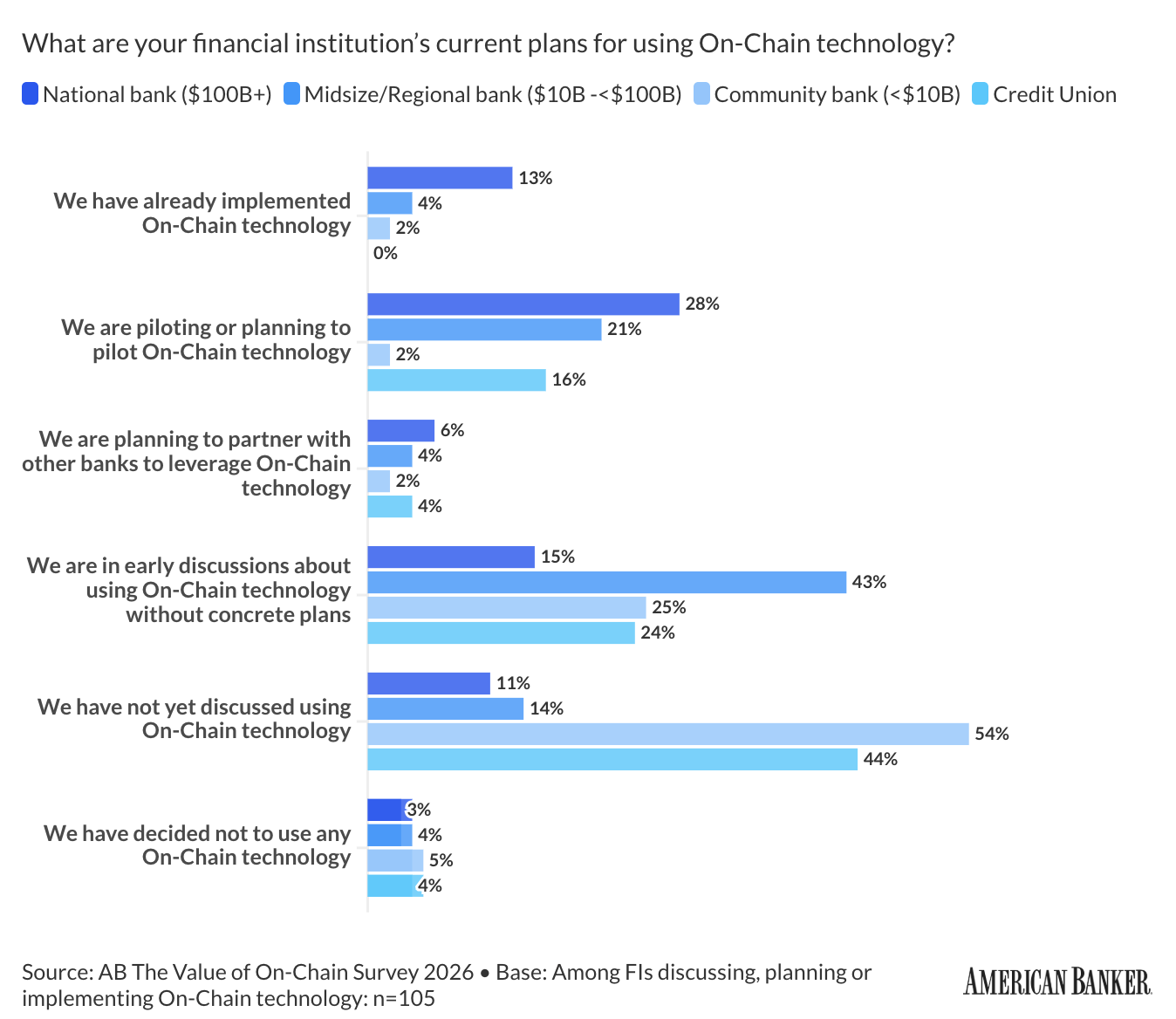
Recent data underscores this gap. According to the American Banker: The Value of On-Chain Survey (2026):
- Only 13% of large national banks ($100B+) have implemented on-chain technology
- But 28% are already piloting or planning pilots
- And a further 15% are in early discussions
Among midsize and regional banks, the pattern is even more pronounced:
- 43% are in early discussions
- Only 4% have implemented solutions
In other words, interest is widespread, but execution remains limited.
Traditional financial systems are built on well-defined processes, trusted counterparties and clear lifecycle management. They are robust, but also fragmented, manual, and often slow.
On the other side, digital asset systems offer innovations such as real-time settlement and programmable transaction logic. But they introduce new complexities, such as unfamiliar infrastructure and operational risk.
The result is a gap. Not a tech gap, but a workflow gap, and nowhere is this more apparent than in credit markets.
Whether in securities lending, repo, or bilateral financing, institutions rely on negotiation between counterparties, clear agreement on terms, ongoing monitoring of obligations, and coordination of collateral and margin.
These workflows were never designed for hybrid environments, so as institutions begin to explore digital asset collateral or on-chain settlement, they quickly encounter friction.
Communication still happens in fragmented channels, transaction terms are not standardized across systems, settlement instructions must be manually coordinated, and post-trade monitoring is disconnected from execution.
In short, the infrastructure for running credit relationships has not kept pace with the assets themselves.
What’s becoming clear is that the next phase of adoption will not be driven by new asset types alone, but by infrastructure that allows institutions to operate across systems.
This is reinforced by the survey data: while adoption is growing, a significant share of institutions—particularly community banks (54%) and credit unions (44%)—haven’t even begun exploring on-chain technology.
My takeaway from this? The gap isn’t just tech readiness; it’s operational readiness. The infra doesn’t need to replace existing systems. It needs to connect them.
Specifically, institutions need tools that:
- allow counterparties to communicate and negotiate efficiently
- support the preparation of transactions across different environments
- provide visibility into obligations and exposures over time
- integrate with both traditional and on-chain settlement mechanisms
Importantly, this isn’t about creating new trading venues or intermediaries. It’s about enabling institutions to retain control of their relationships and processes, while extending them into new environments.
A Practical Approach: Connecting Workflows, Not Replacing Them
At Membrane, we think about this problem in terms of workflow continuity.
Our focus is not on creating a new market or acting as an intermediary. Instead, we provide infrastructure that allows institutions to communicate and negotiate bilateral credit transactions, prepare transactions for execution in their chosen systems (on-chain or off-chain), and monitor positions, collateral, and obligations over time.
This allows institutions to not only maintain full control over execution and direct counterparty relationships, but also their existing custody and settlement arrangements.
In other words, Membrane enables institutions to operate seamlessly across traditional and digital asset environments, without changing how they fundamentally manage risk or relationships.
The Real Inflection Point
The convergence of TradFi and digital assets is no longer theoretical. But the institutions that benefit most will not be those that simply adopt new technologies.
They will be the ones that solve the operational challenge – how to run existing financial workflows across a changing infrastructure landscape. That’s where the real inflection point lies. And increasingly, that’s where the opportunity is.